
Table of Contents
Executive Summary
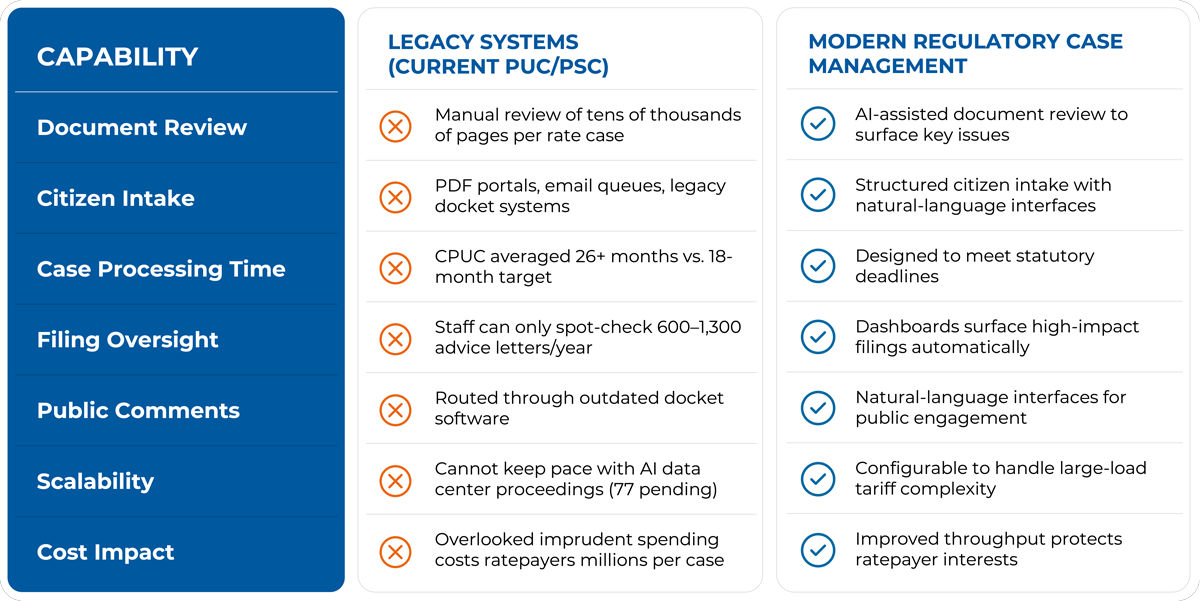
State public utility commissions, designed in the 1970s, are buckling under modern pressures. In 2025, utilities filed $31 billion in rate-increase requests, double 2024’s total, while residential rates climbed 10.2%. Commissions face mounting workloads: 26-month average review times (versus 18-month targets), tens of thousands of pages per rate case, and 1,300+ annual advice letters. AI data center tariffs add further complexity, with 77 pending across 36 states. Legacy docket systems can’t manage citizen comments or surface high-impact filings, causing overlooked costs to fall on ratepayers. Modernizing case management with AI-assisted solutions is now a critical public-interest imperative.
In IT Solutions, Regulatory Compliance Software helps organizations understand and meet government laws, industry standards and internal policies through automating, tracking and risk assessments that support efficient and accurate policy enforcement.
Why are public utility commissions struggling to manage workload?
For most of their century-long history, state public regulation commissions, the that approve electric, gas, and water rates, operated below the public radar. That era is over. In 2025, utilities filed nearly $31 billion in rate-increase requests, more than double the $15 billion requested in 2024, affecting roughly 81 Residential rates rose 10.2 percent between March 2025 and March 2026, and a Consumer Reports survey that month found 68 percent of Americans worried energy costs will become an even greater That pressure lands on commissions whose operating model was designed in the 1970s.
A March 2026 brief prepared for the California State Senate Energy Committee describes the problem bluntly: rate applications “bury regulators in paper and deadlines.” A single general rate case now generates tens of thousands of pages of testimony and data requests. The own regulations call for an 18-month review; from 2017 through 2024 it actually averaged more than 26 months. The state auditor estimated utilities file between 600 and 1,300 advice letters per year against more than 300 balancing accounts, volumes commission staff can only spot-check (CLEE / California Senate Energy Committee, March 2026).
Citizen-facing workload has exploded in parallel. Commissions are statutorily required to log and respond to public comments, complaints, and formal interventions, functions still routed through legacy docket systems, PDF intake portals, and email queues never designed for the volumes generated by today’s politically charged proceedings.
How is AI data center growth impacting utility regulations?
In 2025 alone, state regulators approved 51 large-load tariffs for data centers, with 26 more pending across 36 states (Smart Electric Power Alliance, 2025). Each is a multi-year, evidence-heavy proceeding determining how the cost of powering AI gets allocated between hyperscale’s and ordinary ratepayers.
The National Association of Regulatory Utility Commissioners launched a dedicated large-load initiative in May 2026 in response to the increasing demand by state regulators for educational resources and engagement focused on large loads. (NARUC, May 2026).
What are the costs of delayed regulatory reviews?
When proceedings stretch past statutory deadlines, costs cascade. Utility legal teams bill against multi-year dockets. Ratepayer advocates exhaust budgets before reviewing the most consequential filings. Settlements get approved because litigating them is no longer feasible. A 2026 CLEE brief hosted by the California Senate EUC Committee suggests that limited review of large utility rate cases may allow imprudent spending to go unnoticed and that identifying such spending could save ratepayers millions. Affordability erodes not because regulators are inattentive, but because they are out resourced.
How does regulatory compliance software improve regulatory outcomes?
The fix is not more paper. It is the same shift that transformed courts, tax agencies, and benefits administration over the last decade: configurable case management with AI-assisted document review, structured citizen intake, natural-language interfaces for public comment, and dashboards that surface the handful of high-impact filings hidden inside thousands of routine ones. NARUC, the Deloitte 2026 Power & Utilities Outlook, and all flagged regulatory throughput, not generation capacity, as a binding constraint on America’s energy future.
What should utility regulators do?
For commissions still running on docket software older than the smartphones their commenters use to file, the question is no longer whether to modernize. It is whether they can do it before the next rate case cycle arrives. AI-enabled, easy-to-configure software solutions are affordable and can be installed to enhance your older systems instead of replacing it.
Public Regulatory Compliance Software, CaseXellence Powered By Speridian Technologies- Schedule a Free Demo